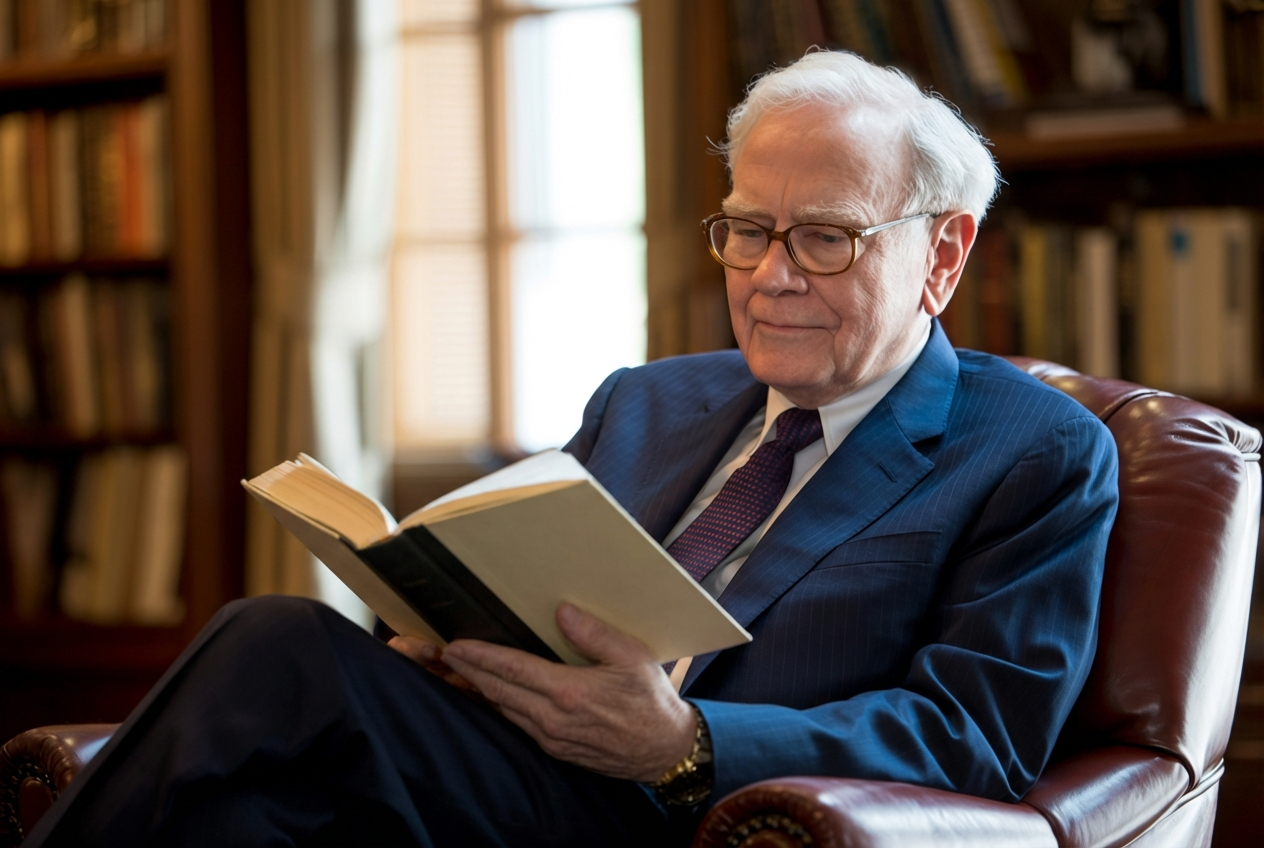
Top 7 books respected by Warren Buffett and Charlie Munger
Warren Buffett and Charlie Munger built one of the most important investment partnerships in history, and both view reading as the foundation of their success. Munger once said that he never knew a wise person who did not read constantly. Buffett estimates that he spends about 80% of his workday reading.
What makes their reading habits interesting is not just the volume, but also the overlap. When both men independently praise the same book, it signals something deeper than personal taste. It reveals the common intellectual framework behind Berkshire Hathaway’s extraordinary journey.
1. “The Intelligent Investor” by Benjamin Graham
This is the book that started it all for Buffett. He called it the best investing book ever written and described reading it as one of the luckiest moments of his life. Graham’s main lesson is that successful investing starts with emotional discipline. The market will constantly tempt you to buy high and sell low, and only investors who treat stocks like real businesses can resist this pull.
Munger shared Buffett’s deep respect for Graham’s intellectual framework, even as he pushed Buffett to evolve beyond strict bargain hunting and buy wonderful companies at fair prices. The foundation Graham laid in this book shaped the way both men thought about risk, the margin of safety, and the difference between investing and speculating.
2. “Security Analysis” by Benjamin Graham and David Dodd
If “The Intelligent Investor” is the philosophical guide, “Security Analysis” is the technical manual. Buffett studied under Graham and Dodd at Columbia University and later wrote the foreword to a later edition of the book. He credited the book and the men behind it with changing his life.
This text taught a generation of value investors how to read financial statements, evaluate bonds, and assess the intrinsic value of a company. Munger respected Graham’s analytical rigor and understood that without this type of fundamental discipline, no investment philosophy could withstand market pressure.
3. “Common Stocks and Unusual Profits” by Philip Fisher
Philip Fisher represented the other half of the intellectual equation that shaped Berkshire Hathaway. While Graham focused on quantitative analysis and buying cheap, Fisher emphasized qualitative factors such as quality of management, competitive advantages, and long-term growth potential. Buffett and Munger discussed Fisher’s philosophy together at shareholder meetings, and Buffett openly recommended his books.
Buffett has described his own investing approach as being about 85% Graham and 15% Fisher, although many observers believe Fisher’s influence has grown over time. Munger played a key role in this development, consistently encouraging Buffett to pay fair prices for exceptional companies rather than bargain prices for mediocre companies.
4. “The Wealth of Nations” by Adam Smith
Adam Smith’s 1776 masterpiece is not a typical investing book, but both Buffett and Munger drew heavily on its philosophical framework. They discussed the book together at Berkshire Hathaway shareholder meetings, exploring how Smith’s ideas about markets, competition, and the division of labor applied to their own business decisions.
Smith’s central observation that free markets tend to allocate resources more efficiently than central planning resonated deeply with both men. They built Berkshire Hathaway around the idea of letting talented managers run their companies with minimal interference from headquarters.
This decentralized approach echoes Smith’s argument that economic systems work best when individual actors are free to pursue productive activity without excessive top-down control.
5. “The Warren Buffett Portfolio” by Robert Hagstrom
Munger publicly praised the book at a Berkshire Hathaway shareholder meeting, calling it a tremendous contribution to the synthesis of human thought on the investment process. He admitted that he had initially rejected it based on the author’s previous work, but after reading the full manuscript he was genuinely impressed. He recommended that each shareholder present purchase a copy.
The book explains the principles behind focused investing, the strategy of concentrating capital in a small number of high-conviction positions rather than diversifying them widely. This approach defined how Buffett and Munger actually invested for decades. Hagstrom captured the mechanics of their philosophy in a way that made it accessible to serious investors who wanted to understand why patience and discipline trump diversification.
6. “Poor Charlie’s Almanac” edited by Peter Kaufman
This collection of Munger’s speeches, essays, and philosophical musings is one of the most unique business books ever published. Buffett wrote the foreword and promoted it with characteristic humor at shareholder meetings, joking that carrying it around would make people look urbane and erudite. Behind the joke was a genuine endorsement of the substance of the book.
The real value of “Poor Charlie’s Almanac” lies in Munger’s concept of constructing a network of mental models drawn from psychology, physics, biology, history and economics. Munger argued that one cannot make good decisions using only the tools of a single discipline.
You need frameworks from many domains working together. This book captures this multidisciplinary approach better than any other printed material and remains essential for anyone who wants to think more clearly about investing and life.
7. “The Strangers” by William Thorndike
Buffett named this book number one on his recommended reading list in his 2012 letter to Berkshire Hathaway shareholders, calling it an exceptional book about CEOs who excelled at capital allocation. Munger separately praised it as a book detailing the extraordinary success of CEOs who took a radically different approach to business management.
Thorndike profiles eight CEOs whose companies have significantly outperformed the market over long periods of time. The common thread was not charisma or operational brilliance but a disciplined allocation of capital. These executives understood that deciding where to deploy cash is a CEO’s most critical task. This principle is at the heart of everything Buffett and Munger have built at Berkshire Hathaway.
Conclusion
The books that Buffett and Munger both respected reveal a clear trend. They valued texts that taught disciplined thinking, rational decision-making, and a deep understanding of how businesses and markets actually worked. These are not get-rich-quick guides. These are serious works that require careful reading and sustained reflection.
The lesson for anyone building wealth is that the right books can reshape your perception of money, risk and opportunity. Buffett and Munger didn’t agree on everything, but when both men pointed to the same book, it was worth paying attention. These seven titles provide a solid starting point for anyone wanting to develop the type of mental framework that produces lasting financial results.
Berita Terkini
Berita Terbaru
Daftar Terbaru
News
Berita Terbaru
Flash News
RuangJP
Pemilu
Berita Terkini
Prediksi Bola
Technology
Otomotif
Berita Terbaru
Teknologi
Berita terkini
Berita Pemilu
Berita Teknologi
Hiburan
master Slote
Berita Terkini
Pendidikan
Resep
Jasa Backlink
Togel Deposit Pulsa
Daftar Judi Slot Online Terpercaya
Slot yang lagi gacor