People who build wealth include Robert Kiyosaki’s cash flow quadrant
The wealth building is not only to earn more money – it is a question of understanding how the different income flows work and are strategically positioning themselves in them. Robert Kiyosaki’s cash quadrant provides a robust framework that reveals why some people build a lasting richness while others remain financially dependent despite high income.
The four road generators: which are you?
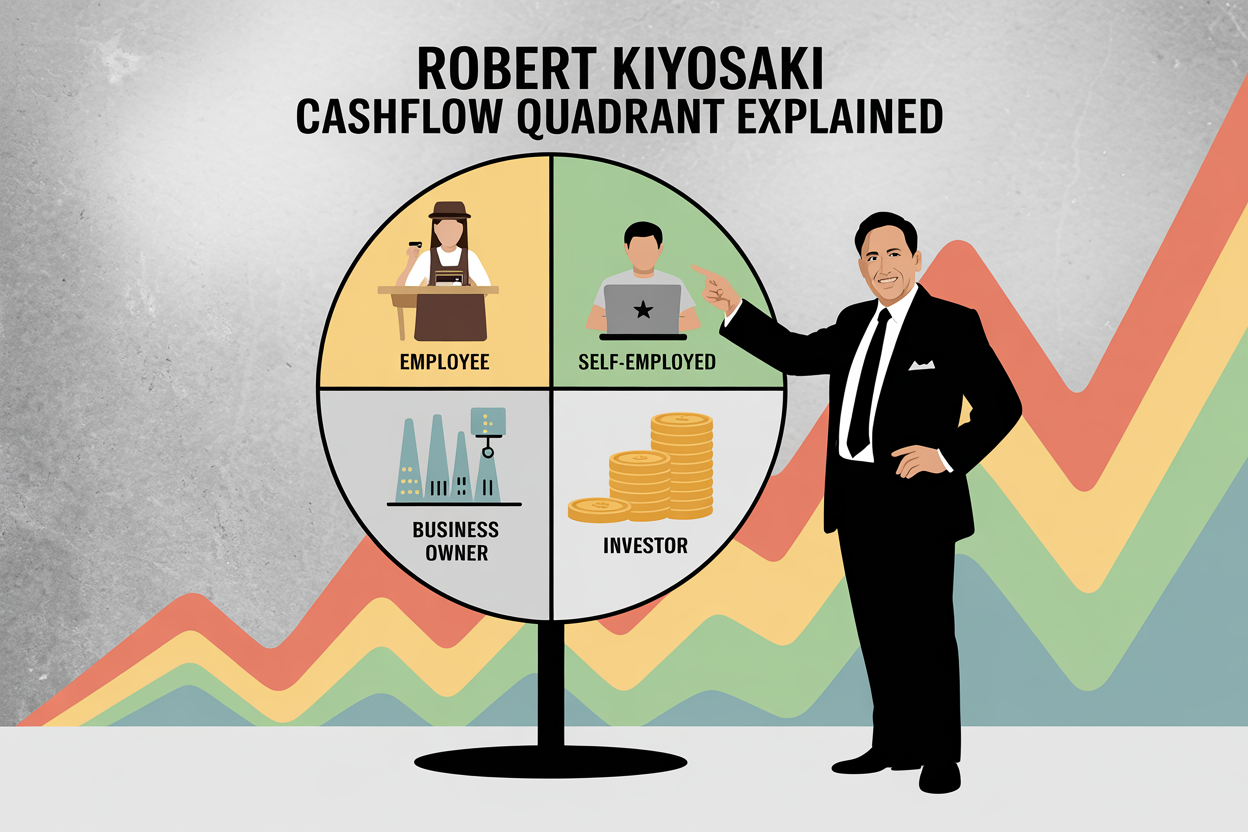
The Kiyosaki model divides the generation of income into four separate quadrants: employees, self -employed workers, business owner (B) and investor (i). Employees exchange time directly for wages, while self -employed workers have their jobs but exchange time for money.
Business owners create systems that generate income without their constant presence, and investors make money work for them via various investment vehicles. Understand in which quadrant you currently take place – and where you want to be – forms the basis of the construction of strategic wealth.
Why most people remain stuck in job quadrants
According to Kiyosaki’s part, most people operate within the employee and independent quadrants throughout their careers. This happens because our education system and our cultural conditioning prepare people mainly for employment, emphasizing employment security on financial independence.
The comfort of predictable pay checks and benefits provided by employers creates powerful psychological anchors that keep people in these quadrants. However, this apparent security includes hidden costs: limited income potential, higher tax charges and complete dependence on others for well-being.
Quadrant employees: negotiation time for security
The quadrant of employees represents the most familiar income model: exchange of time and efforts for wages, wages and benefits. Employees receive valuable compensation packages, including health insurance, retirement contributions and paid holidays, which offer crucial financial security.
However, this security is accompanied by significant limitations. Income growth depends entirely on promotions, increases or job changes, creating natural ceiling effects on the gain potential. The fundamental constraint lies in its linear relationship between time and money – you cannot earn more without working for more hours or get a better position.
Independent quadrant: you have a job, not a company
Independent workers professionals – including working doctors, lawyers, consultants and self -employed – occupy a single position that offers more control than employment but still requires a direct investment for the generation of income. Kiyosaki underlines the critical distinction between possession of a job and possession of a business.
Self -employed workers often work longer than traditional employees and are more responsible for their safety on income. If you do not work, you are not paid, creating a different type of dependence – instead of counting on an employer, the self -employed become prisoners of their business.
Owner of the quadrant company: creation of systems that work without you
The real property of the company occurs when you create systems and processes that generate income without requiring your constant presence or your direct involvement. Business owners take advantage of the time, skills and efforts of others to create wealth.
The key test of business possession is simple: can your business work profitably while you are absent for long periods? This quadrant requires an important initial investment over time, money and energy to build these systems, but once established, it offers unlimited potential.
Quadrant investor: operate your money while you sleep
The investors’ quadrant represents the ultimate expression of the construction of wealth with leverage, which makes money work regardless of your investment in time. Investors generate income through shares, bonds, real estate, business participations and other investment vehicles that produce yields by assessment, dividends, interest or rental income.
This quadrant offers the most favorable tax treatment, as investment revenues often receive preferential rates compared to earned income. The power of compound yields means that the first investors can build substantial richness over time without proportionally increasing their work effort.
The power of the lever effect: how asset owners and manufacturers create real richness
In the Kiyosaki model, the lever forms the fundamental difference between the quadrants on the left side and right side. While employees and self -employed workers are limited by their time and personal efforts, business owners and investors are increasing their impact through systems, people and money.
Business owners take advantage of others by creating teams and creating processes that generate value beyond what any individual could produce. Investors take advantage of money itself, using capital to generate yields that are made up over time, creating an exponential growth potential rather than linear.
From exponential linear: understand the transformation of cash flows
The transition of quadrants based on employment to quadrants based on assets represents a fundamental passage of the potential for linear income to exponential income. In the employee and independent quadrants, income growth follows predictable models with natural ceiling effects.
The right quadrants work differently, offering exponential growth potential thanks to the composition effects, system scale and the multiplication of leverage. This transformation requires patience and strategic thinking, because exponential growth often starts slowly before accelerating considerably.
The strategic path: go from left to right through the quadrants
Kiyosaki recommends a strategic approach to the transition through quadrants rather than trying immediate dramatic changes. The recommended path generally begins with the construction of skills and the accumulation of capital during its employees, using security and stable income to finance education and initial investments.
The key transition occurs by doing the work yourself to build systems that allow others to do the work effectively. This requires reinvesting trade benefits in system development, team consolidation and process improvement rather than increasing personal income.
The change of mentality that separates wealth manufacturers
The most crucial element of the Kiyosaki cash quadrant is not technical knowledge – is the transition from the fundamental mentality of the safety search for wealth creation. Employees and self -employed workers generally focus on earning more money through more complex work, while business owners and investors focus on building assets that generate cash flows.
Wealth manufacturers adopt calculated risks and consider failures as learning opportunities rather than disasters to avoid. They invest in financial education and develop skills in marketing, sales, finances and investments that are generally not taught in traditional education systems.
Conclusion
Robert Kiyosaki’s cash quadrant provides a robust framework to understand why some people build a lasting richness while others remain financially dependent despite high income. Key computer science lies in the recognition that the riches building does not concern earn more money in your current quadrant – it is a question of positioning yourself strategically in quadrants which offer a leverage, scalability and favorable tax treatment.
The most successful wealth manufacturers understand that moving through quadrants is a strategic process requiring education, patience and the desire to think differently about the generation of money and income. By understanding and applying these principles, anyone can start the course of financial dependence on financial independence.
Lifestyle
Game Center
Game News
Review Film
Berita Terkini
Berita Terkini
Berita Terkini
review anime
Gaming Center