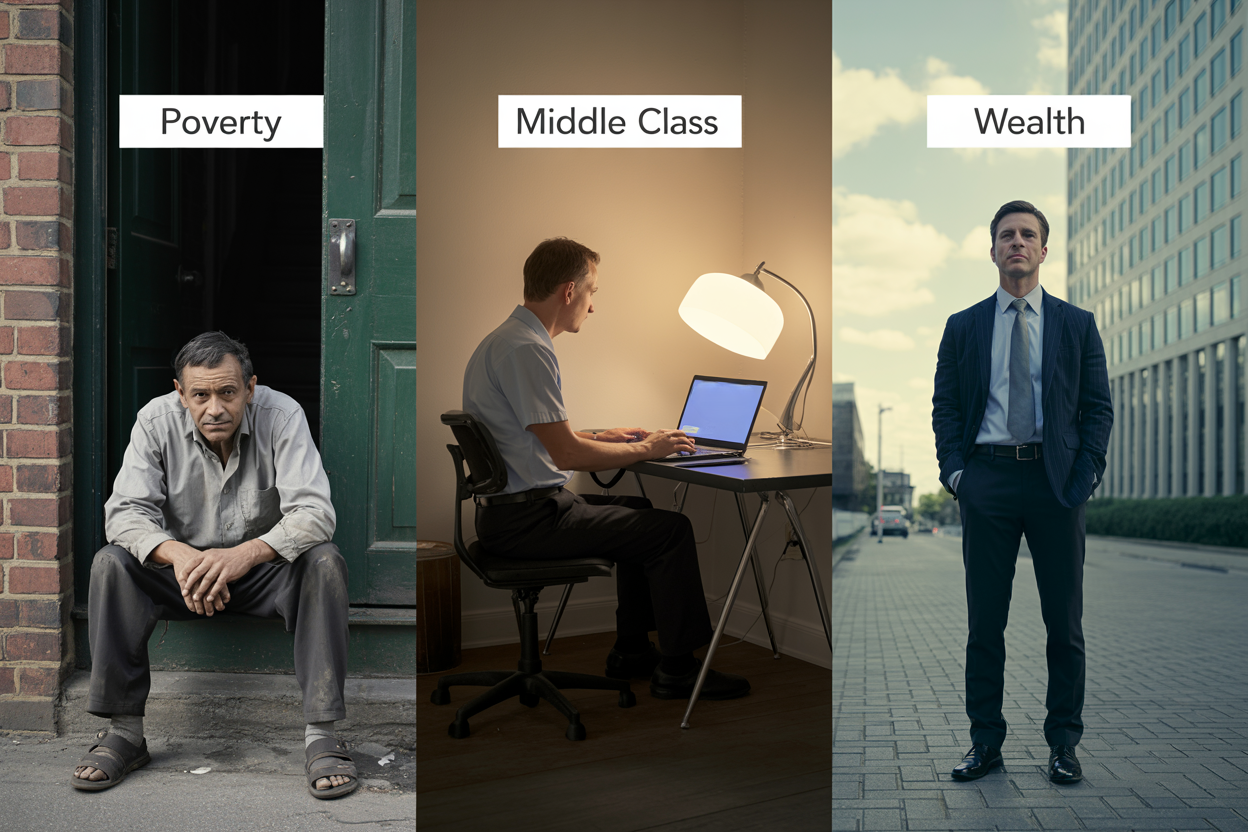
The hidden social class reigns for the poor, the middle class and the rich
Each social class operates by an invisible gaming book – unwritten rules that govern everything, how money is managed to what motivates personal ambition. These hidden frameworks shape the visions of the world, influence daily decisions and create cultural divisions which are often not recognized. Understanding these distinctions does not concern the perpetuation of stereotypes but illuminating the way people of different economic horizons sail in the world.
Money: survival, security or strategy
Perhaps no difference is more fundamental than the way in which each class conceptualizes money. For poor people, money represents immediacy – it is supposed to be spent because survival requires it. When resources are rare, responding to today’s needs has priority about the possibilities of tomorrow.
The middle class considers money as something to manage and plan. Budgets, savings accounts and retirement plans become tools to create security against future uncertainties, carefully balanced balancing current needs with future objectives.
For the rich, money turns into a tool generating wealth. Investment portfolios and commercial companies become the center of interest. Rich people include compound interests, tax advantages and preservation strategies that multiply generational resources.
Which makes someone of value
Each class values different personality traits which reveal what each group must prosper. In poverty, humor becomes essential social currency. Laughing, telling stories and entertainment strengthens community ties, providing crucial support networks.
Especially the realization of the prices of the middle class especially. Diplomas, certifications and promotions define social position. Personal achievements demonstrate self -sufficiency and ascending mobility that characterize the values of the middle class.
Among the rich, connections reign supreme. Who you know determines opportunities and social position. The right introduction can open doors that no individual realization can unlock. Relations are cultivated with care and strategically maintained.
Community: inclusion, independence or exclusion
Those of poverty highlight inclusion because survival often depends on community support. When formal systems fail, informal mutual aid networks become living lines. Nobody gets into account because tomorrow you might need to help yourself.
The culture of the middle class highlights self -sufficiency. The ideal is to manage your own problems and avoid being a burden. This stems from the position of the middle class between poverty and wealth – it is secure enough not to require constant community support but not rich enough to hire aid.
The exclusion of rich practice by private clubs, closed communities and exclusive schools that preserve resources and social capital in established networks. The scarcity of access replaces the scarcity of resources.
Food in time: daily differences
Even universal experiences reveal class distinctions. Food and quantity are most involved in poverty – the priority is to have enough to go around. The middle class focuses on quality, biological products and nutritional value become priorities. For the rich, the presentation becomes essential, with food such as art, experience and social declaration.
Temporal orientation differs considerably. Those of poverty live in the present because the future seems uncertain. Planning is complex when immediate attacks are constantly paying attention. The middle class lives for the future – retirement accounts and career trajectories reflect investment in delayed gratuity. The rich time of the hour through tradition, with family inheritances and multigenerational wealth strategies creating connections that transcend individual lifes.
Education: summary, track or network
For people in poverty, education often remains abstract – disconnected from daily survival needs. The link between class learning and better results is not always visible, especially when the stories of community success have come by other means.
The middle -class families consider education as the main way to success. Notes and diplomas are directly correlated with career opportunities and gain potential, serving as a vehicle to maintain or improve class status.
Among the rich, education focuses on links. Good schools give access to networks that last a lifetime; Who you meet more than what you learn.
Communication and control
Linguistic models reflect the limits of the class. Poverty culture uses relaxed and direct communication focused on relationships. The middle class uses a formal language for professional progress, the change of code becoming essential. Riche communication emphasizes networking subtleties – especially what should not be said and understand implicit meanings.
Family structures follow predictable models: poverty often creates matriarchal structures where women manage resources; The middle class families tend towards traditional or egalitarian models; In rich families, the one who controls money holds power.
The motivations of people differ fundamentally. People in poverty are motivated by relations – the family and the community give meaning when material resources are limited. The middle class is motivated by success and reaching the following level. For the rich, the preservation of wealth and the maintenance of social position become the main concerns.
Destiny: spell, choice or waiting
Perhaps most fundamentally, the classes differ in their direction of control. In poverty, fate is often decisive. When the systems seem to be faked and the efforts do not reliably produce results, to believe that “you cannot control what is going on” reflects the lived experience.
The middle class believes in your choice. The hard work and the right decisions determine the results. Success is won; Failure is preventable by good planning.
The rich operate in expectations. Family inheritance and hereditary responsibility create a predetermined path. Fate is not random fate or pure choice but fulfills the role that wealth creates.
Bridle the ditch
These hidden rules are not moral judgments but cultural frameworks shaped by economic reality. Each class develops values adapted to its situation. The middle class teacher was intrigued by a student who does not provide, the rich employer confused by the family obligations of an employee, the person in poverty frustrated by the formality of the middle class – all these tensions arise from the exploitation by different unwritten rules.
Recognizing these invisible frameworks is the first step towards a real understanding between class lines. It is only by recognizing these different gaming manuals that we can reject divisions and strengthen empathy in a society where the economic background shapes what we have and how we see the world itself.
Lifestyle
Game Center
Game News
Review Film
Berita Terkini
Berita Terkini
Berita Terkini
review anime
Gaming Center