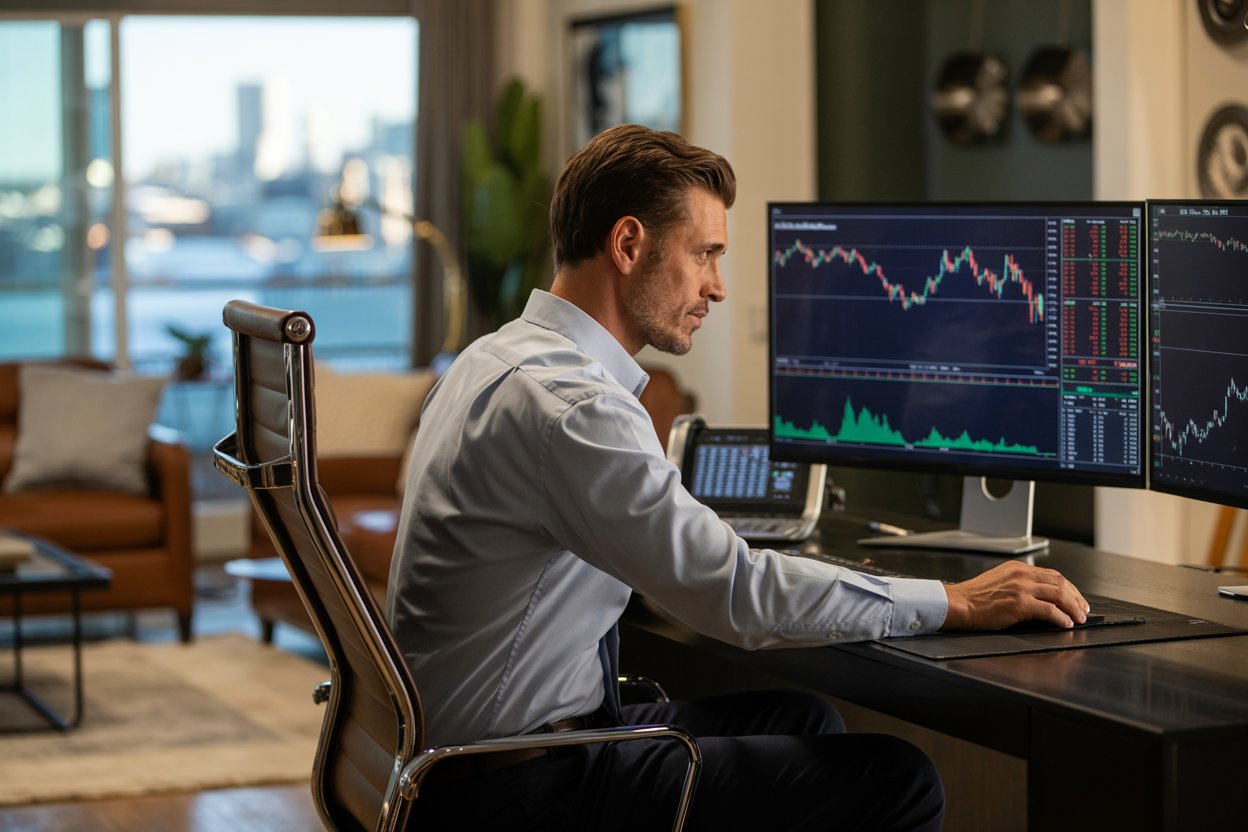
Why Position Sizing is 80% of the Trading Game
Most traders are obsessed with finding the perfect entry point or discovering a secret indicator that will unlock consistent profits. They spend countless hours analyzing charts, testing strategies, and searching for that elusive edge. However, many still struggle to achieve significant returns. The reason might surprise you: they’re focusing on the wrong part of the equation.
According to legendary trader Stanley Druckenmiller, who learned directly from George Soros, position size accounts for 70-80% of trading success. Understanding why this matters could completely transform your approach to the markets.
1. Understand the two components of business success
When you analyze the mechanics of generating excess returns in trading or investing, there are two fundamentally at play. The first is having an edge, which means possessing a belief or mathematical advantage that is not reflected in current market price probabilities. This advantage is what most traders focus on exclusively. This is why they believe their analysis will lead to profitable results that others did not anticipate.
The second element, and arguably the most important, is position sizing. This answers the crucial question: Once you have identified an advantage, how much capital should you allocate to this particular opportunity? The relationship between these two elements (your edge and your position size) ultimately determines your total ability to generate excess returns. You could have the most brilliant market knowledge in the world, but if you only risk a tiny fraction of your capital, the impact on your overall portfolio will be negligible. Conversely, betting heavily on a weak edge can lead to catastrophic losses.
The intuition behind optimal position sizing is simple when taken to the extreme. If you had perfect information and knew with absolute certainty that your trade would be profitable, you would logically bet everything you could. Why not ? Ideal information means guaranteed profits. But in reality, trading exists in a world of probabilities and not certainties. There are degrees of certainty, different levels of conviction, and different qualities of benefit. This is where the art and science of position sizing becomes crucial.
2. The Math of Position Sizing
The mathematical relationship between edge and bet size is not linear, and this is where many traders go wrong. They think that having a slight advantage justifies a proportionately small position, or that a strong advantage means going all-in. The reality is more nuanced. Your position size should take into account not only the strength of your upside, but also the potential downside, the volatility of the asset, the overall size of your portfolio, and your ability to withstand mistakes.
This is why position size has such a big impact on long-term returns. Two traders may have identical win rates and similar advantages, but the one who sizes his positions appropriately will vastly outperform the one who does not.
Undersizing means leaving money on the table when you’re right. Oversizing means taking unnecessary risks that can turn into serious losses when you get it wrong. The optimal approach is to increase your position size in proportion to your conviction level, while maintaining risk controls that prevent a single trade from causing irreparable damage to your capital.
The challenge is to honestly assess your advantage and your level of certainty. Overconfidence leads to oversized positions on poor setups. Excessive caution means missing opportunities where the risk-reward ratio truly justifies aggressive positioning. Finding this balance requires both analytical skills and emotional discipline, which is precisely why so few traders master it.
3. The Soros lesson: quality over quantity
Perhaps no example better illustrates the power of position sizing than that of George Soros, one of the most successful investors of our time. Druckenmiller, who managed money alongside Soros for years, shared a striking insight: Soros made money on fewer than 30% of his trades. Let that sink in. One of the greatest traders in history was wrong more often than he was right. His batting average isn’t what made him legendary.
What set Soros apart from countless other traders was not his ability to consistently pick winners. This he did when he identified a high-conviction opportunity. When Soros had a significant advantage – when his analysis suggested a significant mispricing in the market – he did not simply adopt a standard position. He bet big. And above all, when these positions evolved in his favor, he let them present themselves. He did not make quick profits or exits according to predetermined targets. It has allowed its winners to generate huge gains.
This approach means that Soros likely had many investments that lost money, but those losses were contained. They didn’t lose much because he sized them appropriately to his level of conviction or reduced them quickly when they were proven wrong. But when he did make money, he made considerable sums through the combination of large initial positions and the discipline to let those winning positions grow significantly. This is the essence of position sizing mastery: losing little on your mistakes and winning big on your best ideas.
4. The psychology of letting winners run
Position sizing has a psychological dimension that is often overlooked. It’s one thing to intellectually understand that you should bet more when you have a significant edge. In fact, it’s a completely different matter to do so when real money is at stake. Most traders suffer from risk aversion that causes them to underestimate their best opportunities and exit winners too early.
The fear of making a mistake, losing money, or seeing profits evaporate creates powerful psychological pressure to play it safe. This manifests itself by taking small positions even when conviction is high, or cutting winners to “lock in gains.” But this approach virtually guarantees mediocre results. If you are only willing to risk small amounts on your best ideas and are quick to make profits when you are right, you cannot overcome the inevitable losses when you are wrong.
Letting winners run concurrently with proper initial sizing requires immense discipline. This means watching positions grow to represent larger percentages of your portfolio, which is understandably uncomfortable.
This means staying in trades when your instinct is to secure profits. This means trusting your analysis enough to maintain exposure even if positions become significant. This psychological challenge is precisely why position sizing accounts for such a large percentage of trading success: it’s not just about the math, it’s also about the emotional strength needed to execute the calculations when it counts.
Conclusion
The revelation that position sizing accounts for 70-80% of trading success should fundamentally change the way you approach the markets. Your edge matters and developing strong analytical skills remains essential. But if you fail to translate that advantage into appropriately sized positions, you’re leaving the majority of potential returns on the table.
Soros’ lesson is not that you always have to be right. It’s when you identify real opportunities where you are convinced that you need to act decisively. Size your positions based on the strength of your advantage, protect your capital on uncertain trades and, perhaps most importantly, have the discipline to let winning positions grow.
This approach doesn’t guarantee success, but it aligns your trading with the mathematical realities of how outsized returns are actually generated. Master position sizing and you have mastered the most critical part of the trading game.
Lifestyle
Game Center
Game News
Review Film
Berita Terkini
Berita Terkini
Berita Terkini
review anime
Gaming Center

Related Posts

Sheet Pan Chicken Thighs

Easy Potato Recipes